

Success Stories
Selected projects and results. Hover over a tile to discover the story behind it, then click for the full story.
The introduction and use of cloud services in the Free and Hanseatic City of Hamburg centred on ensuring information security and compliance as well as an operating and governance structure that is viable in the long term and strategically aligned.
The project was highly complex: a large number of specialist departments and organisational units brought in different, in some cases conflicting, requirements regarding usage, security and operations. The aim was to develop a workable, compliant and strategically sound framework for the use of cloud services within this field of tension.
The central challenge was to reconcile the use of standardised cloud services with strict regulatory requirements (particularly in the context of BSI-oriented security specifications and an increased need for protection) while creating practical solutions for the organisation.
At the same time, a key focus was on enabling the many people and different areas of work involved to use the new tools, ensuring broad acceptance and establishing digital collaboration in the cloud across the entire organisation.
thinformatics AG made a decisive contribution to the project through its strong technical expertise and the high quality of its methodological and substantive work. In particular, it brought its experience at the interface of cloud usage, information security and the specific conditions of public administration. This included:
- structured gathering and consolidation of diverse requirements from specialist departments, IT and security
- methodical assessment of protection needs, risks and regulatory requirements
- derivation of a workable target picture for the secure and compliant use of cloud services
- establishment of robust governance and decision-making structures
- facilitation and support of committee and stakeholder processes across various levels (including specialist committees, management and executive level)
- design and support of change and adoption measures for the organisational introduction and widespread use of the cloud services
- design and delivery of structured information and communication formats as well as target-group-specific qualification and enablement measures
- promotion of cross-departmental exchange and the establishment of sustainable community structures to increase the use of the cloud services and M365 products
- data-based analysis of usage for targeted optimisation and adjustment
A key success factor was the ability to mediate between different interests and turn them into a jointly supported, workable solution.
Alongside this, change management tailored specifically to the client’s situation made a significant contribution to establishing the use of cloud services on a broad basis. The services were therefore not only provided technically, but also anchored sustainably within the organisation and used effectively in day-to-day work. At the same time, this made an important contribution to the overarching process of change towards a modern, digital way of working.
The result is secure and compliant usage that meets both the regulatory requirements and the various specialist needs, and thus forms a reliable basis for ongoing operations.
The project’s success is based on the close, partnership-based cooperation between the Free and Hanseatic City of Hamburg, the organisations involved and thinformatics AG, with project management anchored on the client side and specifically supported by the consulting services.
Client, partner & project background
To modernise its digital structure, a client in the finance and insurance sector decided to migrate its data, applications, workflows and all of its communication from Lotus Notes to SharePoint. The company’s continuous expansion had pushed the Lotus Notes solutions used for internal communication, document and information management and workflow automation to their limits. To further improve collaboration, efficiency and scalability, the company decided to rely on Microsoft technologies in future.
In a strictly regulated sector such as this one, smooth implementation is crucial: maintaining data integrity and preserving existing functionality were the main priorities, as were improving usability and ensuring a seamless transition with minimal disruption to day-to-day operations.
To secure the success of the digitalisation project, the client decided to draw on our expertise as a long-standing Microsoft partner.
The migration scenario was to be delivered hand in hand with a modern and robust solution. Previous collaboration and experience from earlier projects, together with the expertise in both Lotus Notes and Microsoft products available on either side, led to a successful partnership with AvePoint on this project.
Project process
To determine the exact scope of the migration, the first step, carried out together with AvePoint, was a comprehensive assessment of the existing Lotus Notes environment. Based on an analysis of the databases, an understanding of the workflows, the identification of critical data and the mapping of dependencies, a tailored migration strategy was developed that covered every requirement.
Detailed planning of the approach was central to this. Using AvePoint’s migration tools, it was possible to develop a tailored migration scenario in order to identify and resolve any differences in data types, metadata or functionality between the two platforms. In every migration phase, the accuracy, consistency and functionality of the data were ensured through test scenarios; AvePoint’s tools enabled continuous monitoring and troubleshooting throughout the migration process.
We successfully migrated the critical data, applications and workflows from Lotus Notes to SharePoint within the agreed timelines and without any significant disruption to business operations. In addition, SharePoint’s intuitive user interface and extended functionality increased user satisfaction and productivity.
Throughout the project, AvePoint’s expertise in migration tools and SharePoint solutions complemented our in-depth understanding of Microsoft technologies and our ability to identify where they could add value to the client’s business processes.
“thinformatics acted as a consistently reliable partner. The good communication and the strong commitment on both sides made it possible to make the necessary adjustments and changes and to implement the corresponding measures immediately,” says Robert Beckel, Senior Solution Consultant, AvePoint.
Conclusion
The successful migration from Lotus Notes to SharePoint transformed the client’s digital infrastructure for the long term. The project not only modernised the systems, it also laid the foundation for continuous innovation, better collaboration across departments and sustainable business growth. The operating costs associated with maintaining outdated systems were also eliminated. On top of that, SharePoint’s scalability allows for future expansion and integration with other business tools.

We are proud to contribute to the Nordstern programme as a long-standing partner of Dataport and to help shape the future infrastructure of the public sector.
Dataport is the information and communications technology service provider for the public administration of Schleswig-Holstein, Hamburg, Bremen and Saxony-Anhalt, for the tax authorities of Mecklenburg-Western Pomerania and Lower Saxony, and for the “IT-Verbund Schleswig-Holstein AöR (ITVSH)”.
The Nordstern programme
With its Nordstern programme, Dataport supports the staff of Germany’s public administration in using their specialist and productivity applications securely, quickly and reliably over secure network connections.
To this end, the programme designs and builds the following epics (solutions):
- An automated delivery pipeline for specialist applications, from development through to production
- Cloud services (IaaS and PaaS) that can be provisioned and managed via a self-service portal by a technical application manager (at Dataport and in the public administration)
- A software-defined data centre (SDDC) with points of delivery (PoD) that can be provided both centrally and close to customers (edge)
- A high-performance, highly available core network to which the customer sites of the supporting bodies as well as the networks of other federal states can be connected
- A software-defined wide area network (SD-WAN) that provides secure connections between customers and the SDDC across any transport network
The migration to IPv6 and the Sovereign Cloud Stack are projects within the Nordstern programme. A mini WAN and a reference data centre have been set up for these projects. The reference data centre is a functional copy of the Dataport Twin Data Center. The IPv6 migration project is tasked with migrating all base services, applications and clients to IPv6. The Sovereign Cloud Stack project tests the “enterprise readiness” of the Sovereign Cloud Stack.
The reference data centre
As a long-standing partner, we are responsible for building and managing the reference data centre within the Nordstern programme. A key area of responsibility is gathering the requirements for the reference data centre and coordinating the integration and migration of more than 8 “base systems”, over 67 “base services” and more than 1,000 “applications”. We also ensure stable operation of the reference data centre and establish sustainable maintenance processes.
“Base systems” form the backbone of the reference data centre and include Windows servers, Unix servers as well as the firewall and virtualisation infrastructure, among others.
These systems host “base services”, which provide key infrastructure components and services such as the backup infrastructure, SCOM, SCCM, Docker and Kubernetes.
“Applications” refers to the programs & applications that are in use at, or are being introduced to, Dataport’s government and municipal customers. The IPv6 migration is tested in groups: applications that use identical base infrastructure components (base systems and base services) are grouped together. The migration test for one application is therefore representative of its entire application group.
The Nordstern programme: a bridge to a secure and scalable future for the public sector
Migrating the IT infrastructure of the public sector in several German federal states and municipalities to the new IPv6 protocol lays the foundation for future digital development in public administration and has a considerable impact on the efficiency of government services. Integrating and migrating more than 8 base systems, 67 base services and over 1,000 applications requires close cooperation with a wide range of specialist departments.
Our goal is to keep contributing to the success of the Nordstern programme by introducing innovative operating processes and focusing on standardisation in the reference data centre. We are shaping the secure, scalable infrastructure of the future for the public sector in Germany.
We are proud of the responsibility of helping to shape the future of the public sector in Germany and of making an important contribution to the security and scalability of this critical infrastructure.
Collecting and safely disposing of waste from private households and businesses: in short, these are the traditional tasks of AbfallWirtschaftsGesellschaft mbH (AWG). Modern treatment plants at the Bassum waste management centre ensure that waste is treated and recovered to a high standard. In addition, alternative energy generation has emerged as another key area of activity in recent years.
AbfallWirtschaftsGesellschaft mbH (AWG) has decided to replace its previous antivirus solution with Microsoft Defender for Business. This decision was taken because AWG is already firmly embedded in the Microsoft ecosystem and the existing licences allowed for a seamless changeover.
Microsoft Defender for Business offers a comprehensive security solution that meets AWG’s modern requirements. Its cloud-based architecture enables central security management, which is particularly important because AWG works with sensitive data from private households and commercial businesses. The decision in favour of this security solution underlines AWG’s willingness to innovate. The partnership with Microsoft allows AWG to use state-of-the-art technology while continuing to fulfil its responsibility for the environment and the region. With Microsoft Defender for Business, AWG is ideally positioned to secure its processes, protect sensitive data and drive its sustainable development forward at the same time. This step marks a strategic course setting for future excellence in a changing technological environment.
As a long-standing partner, we supported AWG on the path to implementing Microsoft Defender. We were not only the technical implementation partner, but also an adviser for planning and design. Our expertise and experience in IT security and in delivering security solutions helped the project run smoothly. We were at AWG’s side from the very beginning, from planning and configuration through to training employees and providing ongoing support. Our goal was to make sure that AWG benefits fully from Defender and that its security infrastructure is strengthened. Our close cooperation helped drive the company’s digital transformation forward successfully.
The implementation was carried out in three consecutive phases, or groups, in order to encourage user acceptance, to give the IT department the room to handle its operational requirements and to respond flexibly to changed, new or additional requirements:
- Phase 1: In this first phase, the tool was initially rolled out on the IT department’s clients in order to test and confirm its basic functionality. This made it possible to identify and address any adjustments or issues at an early stage.
- Phase 2: In the next phase, Defender was also implemented on the clients of a specifically selected group of pilot users. This provided the first insights and experience with Defender, which in turn were used to train the administrators. This phase offered the opportunity to gather direct feedback from users and to adapt the necessary training measures at the same time.
- Phase 3: The final phase focused on the rollout to the remaining clients in the company. The experience gathered and the feedback received in the previous phases were taken into account to ensure a smooth implementation for the wider user base.
In summary, the introduction of Defender for Business has been a complete success at AWG. The old on-premises solution was replaced by the already licensed Defender, and the change had only minimal impact on users. Targeted training and continuous operational support from the thinformatics team ensured seamless integration. AWG has therefore not only modernised its security infrastructure, but also enabled its employees to use the new security mechanisms effectively and to carry on with their daily work undisturbed.
We look forward to continuing our successful cooperation with AWG and to supporting them further on their journey towards digital transformation. This includes providing consulting and technical support for day-to-day operations to ensure that AWG’s IT security infrastructure is always up to date. We are also looking forward to future projects and challenges where we can contribute our know-how and experience to help AWG achieve its goals and continue to play a leading role in the waste and circular economy.

A success story spanning the globe
LEONI is a global provider of products, solutions and services for energy and data management in the automotive industry. The listed group employs around 100,000 people (approximately 73,000 of them front-line workers) at 50 sites in 28 countries and generated consolidated sales of 5.1 billion euros in 2021.
LEONI’s vision: a modern, user-friendly and extensible collaboration and communication platform. This meant taking into account not only the requirements of the various business areas and project groups, but also collaboration with external customers and partners, which was a key factor. It also called for a solution that would meet LEONI employees’ expectations of a modern and attractive working environment.
The first obstacles became apparent right at the start: digital collaboration within the company was very difficult because of a highly heterogeneous landscape of technical tools and widely differing local setups across the global infrastructure. As a result, local solutions had emerged that did not support the idea of a single, worldwide solution. In some cases these posed a security risk and left employees unsure which application they were supposed to use.
The corporate strategy called for a move towards cloud solutions, so the focus was primarily on platforms that would deliver collaboration features in the best possible way.
It quickly became apparent that Microsoft Teams and the integrated M365 solutions met the requirements in full, and user licences were already available on a large scale. This allowed LEONI and thinformatics AG to launch the Teams rollout project together in May 2021.
One of the most important factors for the successful introduction of Microsoft Teams was involving and continuously training all users at an early stage. This took a variety of forms:
- basic training as well as training tailored to specific target groups
- guides (manuals & flyers)
- training videos
- learning paths with videos & quizzes (integrated into LEONI’s internal learning portal)
The Champions Community was another central element of the project. Within this community, more than 50 proactive and interested employees from the specialist departments were empowered to become “champions” through dedicated expert training and workshops, and a shared Teams community was set up. This greatly encouraged the internal exchange of knowledge about using Microsoft Teams, and was supplemented by regular information on new features and changes in Microsoft 365 as well as moderated champion meetings on specific use cases.
As with many cloud projects, data protection & information security played a major role throughout. Thanks to close cooperation between the project teams and the relevant committees, however, concerns, questions and risks were identified and resolved at an early stage. An important goal was to enable end users to use Microsoft Teams as effectively as possible to cover their own business requirements. At first, strict regulatory and organisational requirements (governance, for example) and data protection considerations appeared to run counter to this idea.
With the help of supporting low-code tools, Azure-based automation, an integration of the ITSM tool and precisely tailored adoption & change instruments, a good and constructive compromise was nevertheless reached: LEONI AG users can use Microsoft Teams and features such as Planner and whiteboards on their own responsibility within a defined framework.
To keep the creation of new teams controllable and transparent, LEONI uses an app within the Teams platform that has been adapted to the company’s needs and requirements. It is available to every user, and an intermediate approval process before the final team is created supports the four-eyes principle.
From a security perspective, the company also draws on the tools already available in the M365 portfolio to automatically dissolve teams that are no longer needed and to remove members who no longer need to be part of a team. Standard labelling is used for longer-term document archiving.
Teams has replaced, and continues to replace, communication and collaboration platforms such as Cisco Jabber & WebEx as well as other isolated solutions. The goal: to reduce the complexity and scope of the application landscape for users, to save licence costs and to create an optimised integration into the IT infrastructure.
With the introduction of Teams, departments, teams and projects now have tools for digital collaboration at their disposal. Microsoft 365 solutions such as Planner and Whiteboard are actively used and support even more efficient collaboration. Digital collaboration on documents can also take place in real time across all international sites, an enormous advantage for a company with around 100,000 employees on several continents.
To complete the basic implementation of Teams, the option was created to easily involve guests and external parties in communication and collaboration on the platform. A milestone and an improvement when it comes to effective collaboration with customers, service providers and suppliers.
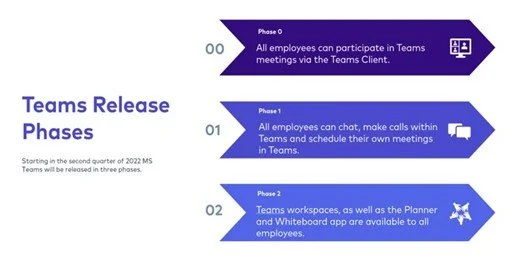
The implementation took place in three phases. The goal: to support user adoption of the tool, to give the IT department the room to handle its operational tasks and to respond in an agile way to changed or new requirements:
- “Phase 0”: client deployment. The aim was to allow all employees to join existing Teams meetings (invitations from customers, service providers, etc.) without using the browser. At the same time, this laid the groundwork for actively using the Teams features later on.
- “Second phase”: the first release of features that could be actively used in Teams. Here, users were given communication functions so that the familiar use cases of the previous solutions could be covered with Microsoft Teams.
- “Final phase”: provision of the basic collaboration features. This included team rooms in Teams (including defined app integrations such as Planner, Whiteboard, etc.) to give employees a comprehensive solution for internal and external collaboration.
The individual rollout phases show a continuous increase in usage across the company.
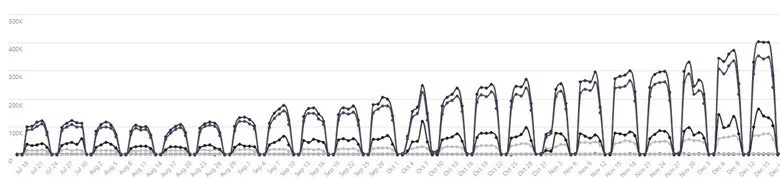
In the area of communication, usage figures rose and continue to rise steadily.
Monitoring also reflects the launch and release of the collaboration capabilities with considerable growth:
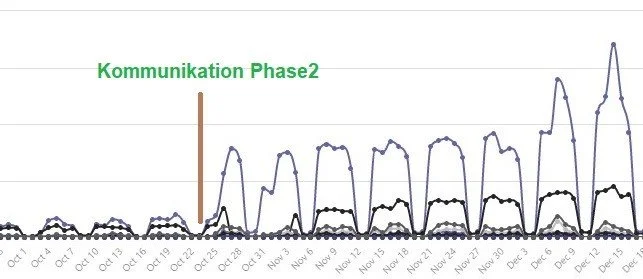
After just 8 weeks, LEONI employees had already created more than 450 teams. Of the roughly 19,000 employees with PC access, more than 50% were using the new application within a short space of time.
The conclusion: the introduction of Teams was a complete success thanks to the involvement of the relevant areas and stakeholders, the early and continuous enablement of users and the phased rollout. With Teams and other M365 apps, LEONI employees now have a wide range of efficient tools for digital collaboration within a single platform, and there are no barriers to getting started thanks to precisely tailored user training, the champions programme and expert support.
A real milestone, but by no means the last one on our journey …
Together with LEONI, we are planning the data migration to SharePoint Online, extensions to the information architecture in M365 and the implementation of automated Teams lifecycle processes, among other things. The goal behind all of this remains clear: to equip employees with THE best possible collaboration platform!